Sewing my first coat is definitely my most personally challenging sewing project to date. I loved the process of its creation, and I am over the moon happy with the final result.
This coat adventure started this past fall. On a daily news website I frequent (though not as much as I should), there was a coupon code for online shopping at J Crew. I haven’t shopped at this retailor in many years, but I decided to take a look. Their website was offering a sale on outer wear, and I fell in love with this pink wool coat. Pink is my absolute favorite color. This coat was a dream. But even though the coupon code could be applied to the sale price, I could not justify purchasing another coat.

I live in New Hampshire where the season of winter has many sub-categories. It begins in the chilly late autumn of November, then the light winter of Christmas time, but moves quickly into the real winter of January and the deep freeze of February. In March the cold lingers and is blustery, and while April stores stock sleeveless dress for Easter, insulated jackets are still in style up here. There is no one-coat-fits-all-winter in Northern New England, and my closet covered each phase of chilly.
However, I convinced myself that I could learn to sew a coat. This would be a “slow sew” and teaching project. This I could justify. I pondered this. I motivated myself with Episode 71 of the “Love to Sew” podcast while I researched patterns and materials. Pondered. Researched. Pondered. Researched. Finally, I started ordering.

I chose the Yates Coat from Grainline Studio for it’s simplicity and modernity in some of the details. I was drawn to the shape of the lapel and the front pockets. Also, the relaxed fit of the pattern let me feel the same as I knew there would be room for forgiveness if the fit wasn’t on point.
And of course the coat was going to be pink. That is what kick started this whole adventure in the first place. I purchased my fabrics online at MOOD. The self (outer) fabric is an Italian wool boucle. And if I am the creator, then I had the choice of linings too. I opted for a bright sunny yellow china silk/habotai because that’s a color combination that can’t be found everyday. If I got myself lost in a snow bank there’s no way I wouldn’t be found with my glowing outer wear.
To provide extra warmth, I lined the front and back of the body of the coat with Thinsulate that I purchased online at Vogue Fabric Store. This step is not part of the original design of the Yates Coat. This decision was influenced by my New Hampshire residence–and it worked as I am so toasty! I opted not to do the sleeves because I thought it would make them too rigid. Closet Case Patterns has an excellent blog post explaining how to line a coat with Thinsulate.
Another basic requirement to complete this pattern was fusible interfacing. I discovered quality interfacing in my research. In previous sewing projects, I was only familiar with the thinner white interfacing that tore apart in my hands when pulled. This did work great for lining parts of a tote bag, but I learned this would not be strong enough for a wool coat. I found a sturdy medium-weft fusible interfacing at Blackbird Fabrics. When ironed onto the back side, it helped to give the wool support and structure.

An online article by Singer offered guidance on choosing the right sewing needles for this project.
When constructing the coat, I followed along with the instruction booklet that came with the pattern while also referring to the corresponding blog posts found online at Grainline Studio. I progressed one step at a time with the booklet while the blog post offered colored photos and grouped the steps together for me into manageable tasks.


Never have I cut so many pattern pieces!
Making a muslin was a must. Mandatory. An absolute. In creating this sample, I discovered that the sleeves were a bit snug at the top of my arm. (Probably due to my bulging biceps, right?!) I adjusted the pattern then, so I used one size up for the shoulders, arm holes, and upper arms and then graded down to my regular size for the lower arms.

And then came to the infamous step of “bagging” or “birthing” the coat. I heard and read about how crazy this is and the impossible feeling that confronts the sewer as well. I actually shared a video of myself on Instagram trying to gently fight all the fabric and lining through a small hole in the lower inner arm. What an engineered process that is pretty amazing to experience!

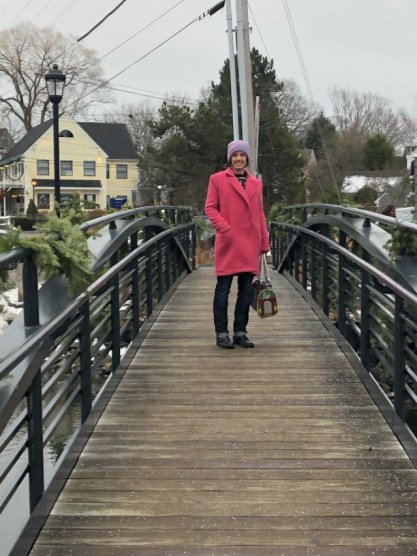


I love this coat! I love wearing the clothing I sew myself. And I can wear this make every day! I am glad I accepted this challenge for myself. Planning ahead, taking it step by step, and embracing the process helped me succeed. I am looking forward to adapting these thoughts to my next project!

 The Pink Lily Pad and Two Tadpoles