Several years rolling now, I have hosted a St. Patrick’s Day party at my home. One of the usual attendees was absent this year, and she was the one who always brought the soda bread. While my local supermarket has a wonderful bakery, I decided to make the bread myself. I knew it wasn’t a yeast bread so for party planning purposes, the recipe would be simple to incorporate.

Soda bread has become associated with Ireland, but the earliest reference dates to the Native Americans who used soda ash to leaven their bread. Although it would seem easy enough for the recipe to travel back east over the Atlantic, soda bread seems to have developed on its own in Ireland in the 19th century. The country became poverty stricken due in part to a potato famine. The Irish relied on simple ingredients including using soft wheat flour which did not need yeast to make bread. The hard wheat flour required yeast for a proper rise. Along with this soft wheat flour, the Irish combined bicarbonate of soda, soured milk, and salt. This sour milk (or buttermilk) in the dough contains lactic acid which reacts with the baking soda to form tiny bubbles of carbon dioxide. The bread was cooked over an open hearth in a cast iron Dutch oven called a bastible. This resulted in a dense, slightly sour loaf with a hard crust and tender insides. Each region of Ireland had created it’s own variations. In the south, the Irish sliced a cross on top of a round loaf before baking. While this symbol helped with the cooking process, it has also been said it’s wards off the devil. In the north, the dough was flattened into a round disc, then divided into 4 equal parts before baking.
As stated previously, true Irish soda bread contains only flour, bicarbonate of soda (baking soda), soured milk, and salt. Added ingredients, referred to as “alterations,” include caraway seeds, wheat germ, raisins, dried tomatoes, and nuts, but are not considered traditional. A loaf of soda bread with raisins is called a “Spotted Dog.” Modern day versions also contain eggs and milk.

I created my version of soda bread with gluten free flour. Because of this ingredient, and its tendency to be crumbly in general, in an already dry food, resulted in me using a recipe that called for eggs and milk. I added the alterations of caraway seeds and raisins–simply because I like their flavors.
Ingredients:
- 1 3/4 gluten free flour (I use Bob’s Red Mill 1:1)
- 2 tablespoons granulated sugar
- 2 teaspoons baking powder
- 1 teaspoon baking soda
- 1/4 teaspoon salt
- 1/2 cup raisins
- 1 tablespoon caraway seeds
- 1 cup buttermilk or sour milk
- 3 tablespoons canola oil
- 1 egg
Directions:
- Preheat over to 350 degrees. Grease a round 8 inch cake pan.
- Combine dry ingredients in a large bowl: flour, sugar, baking powder, baking soda, and salt. Mix in raisins and caraway seeds to coat them.
- Combine wet ingredients in a smaller bowl: egg, oil, milk and whisk until blended
- Add wet ingredients to dry ingredients all at once. Stir just until combined. Form dough into a ball and transfer to the prepared cake pan.
- Using well floured hands, flatten the dough ball slightly while still keeping a dome shape to the middle. The edges of the dough should not touch the sides of the pan–keep a 1/2 space between the dough and the pan. Cut a cross in the top with a knife.
- Bake for 30-35 minutes until the bread is golden brown. A toothpick in the center should come out clean when it is finished. Cool on a wire rack.
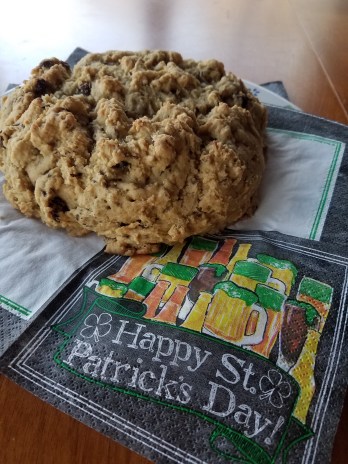
I did make two loaves of this recipes. The other loaf was more “domed” shaped as I described in my instructions. But I ate it before I took the photos. It was delicious. I ate it for breakfast, and it was the perfect snack during the day. I also ate it for dinner one night too. I enjoy my soda bread.

 The Pink Lily Pad and Two Tadpoles
One thought on “Irish Soda Bread”